
Punjab's oldest political allies are back together after six years of acrimony over the three farm laws.
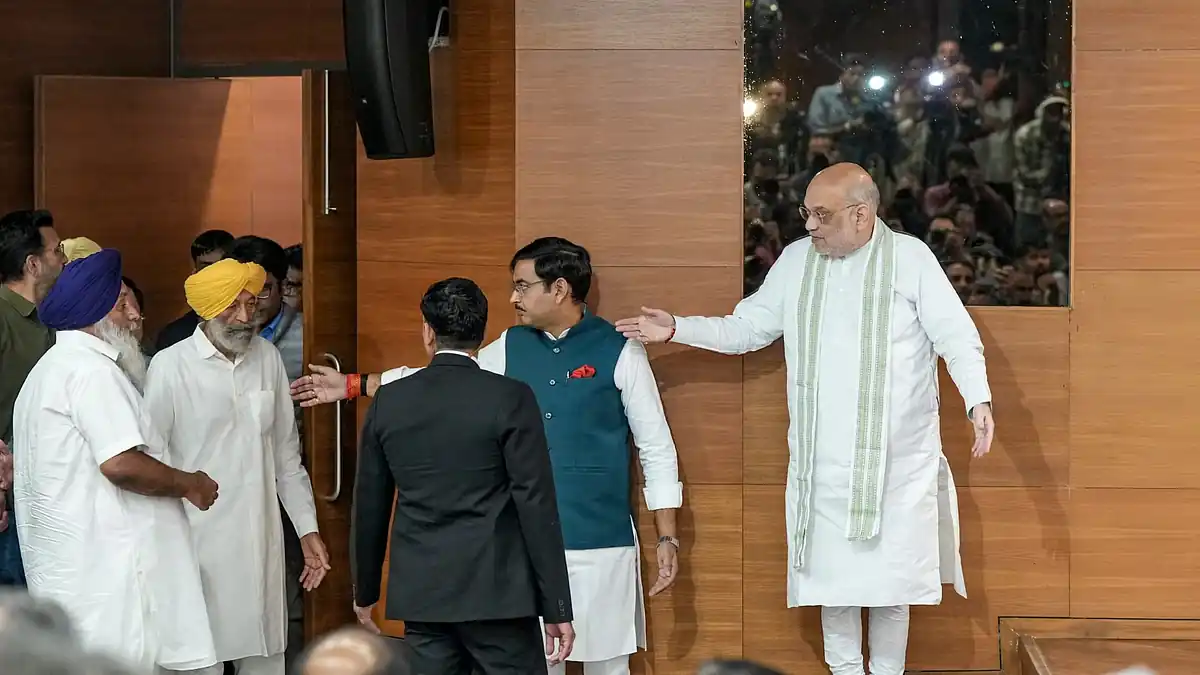
On Tuesday afternoon, Union Home Minister Amit Shah and BJP national president Nitin Nabin shared a dais with Shiromani Akali Dal chief Sukhbir Singh Badal at BJP headquarters in New Delhi. It was a well-thought-out timing. It was Guru Nanak Jayanti, the very day that Prime Minister Narendra Modi had in 2021 proclaimed the rare overturning of the controversial farm laws.
But Shah did not leave the big question on the pact unanswered. "The Akali Dal is once again a partner in the NDA," Shah told reporters, adding that if the Akali Dal wins in 2027, the "bada bhai" (big brother) Akali Dal will get the chair of chief minister."Now NDA is complete," Shah said, revealing that Modi had called Badal to express his happiness. Shah said Nabin and Badal had drawn up a roadmap for Punjab in the past three months, describing the alliance as a "symbol of Hindu-Sikh fraternity". He also declared a deadline for freeing the state of drugs by Dec. 31, 2029.
Soon Modi took to social media to rally the sentiment. The alliance that will provide "pro-people governance" and "has stood the test of time" was "built by Atal Bihari Vajpayee, LK Advani and Parkash Singh Badal," he wrote earlier.
Badal termed the reunion a rescue job. "It is not a political deal but an emotional alliance," he asserted and claimed the coalition would sweep over 100 of the 117 seats in Punjab. He attacked the ruling Aam Aadmi Party, saying that "team Kejriwal" had plundered Punjab with drug mafias and rampaging gangsters.
Take away the nostalgia, and the math of Tuesday's handshake is brutal.
From 2007 to 2017, Punjab was ruled by the BJP and SAD for a decade, a marriage of convenience between the Akalis' rural vote base among Sikhs and the BJP's upper-caste and urban vote base among Hindus. The partnership fell apart in September 2020 after the Akali Dal quit over the farm laws and Harsimrat Kaur Badal resigned from the Union Cabinet.
In the 2022 Assembly elections, the AAP swept through the state, winning 92 seats. The Akali Dal was confined to 3 seats, and the BJP could get only 2. And it was more of the same in the 2024 Lok Sabha polls, where Akalis could scrape through with just one seat and BJP fetched a blank.
But the split has actually increased the BJP's vote share in Punjab. That shift is proving the hardest sell ahead. Earlier the Akali Dal had contested 94 seats and offered 23 to the BJP. The BJP has more than doubled its earlier tally and is now eyeing almost 40 seats, NDTV sources said. Nitin Nabin declined to reveal the numbers on Tuesday and said: "We will work out seat-sharing later."
It will also be the alliance's first real trial in the 2027 campaign without Akali patriarch Parkash Singh Badal, who died in April 2023.
Opposition pushback, missing face
AAP national convener Arvind Kejriwal ridiculed the on-off relationship. "They come together on power point and come apart on power point and come together on power point," Kejriwal said, claiming that the only bonds AAP would forge were with Punjab's women, farmers, traders and Scheduled Castes. "It was the Akali-BJP years when the drug menace in Punjab grew the most," AAP's Saurabh Bharadwaj said.
Punjab Congress chief Pargat Singh was equally blunt. He described the pact as "directionless alliance out of greed for power" and told Sukhbir Badal to "tell voters why you left the NDA to begin (with)." Leaders of the rival camps also dismissed the electoral calculations as "zero + zero = zero."
Even the lack of one sent tremors in the BJP. Former Punjab CM Captain Amarinder Singh, who was no silent player in that tireless battle he was waging to forge an Akali-BJP tie-up, was conspicuously absent from the Delhi announcement. His absence prompted fresh speculation in Punjab political circles about whether the veteran leader himself is having second thoughts about his next move.
So What's the Tricky Part about this Deal?
A split of seat sharing between the two sides remains to be finalized, and convincing Akali Dal leaders of giving about 17 traditional seats to BJP will not be an easy task.
Or, for that matter, how the farmers of Punjab will react when Akali and BJP candidates start canvassing together in the rural hinterlands, where memories of the protests of 2020 are still fresh.
Meanwhile, a wider Punjab battlefield is fluid. Meanwhile, another political front, apart from Gill's Punar Surjit, Waris Punjab De, and BSP, is already in discussions. So as the campaign intensifies next year, it remains to be seen if the resurrected NDA will be able to retrieve the old vote bank or new challengers will only further divide the anti-incumbency vote.


Comments 0