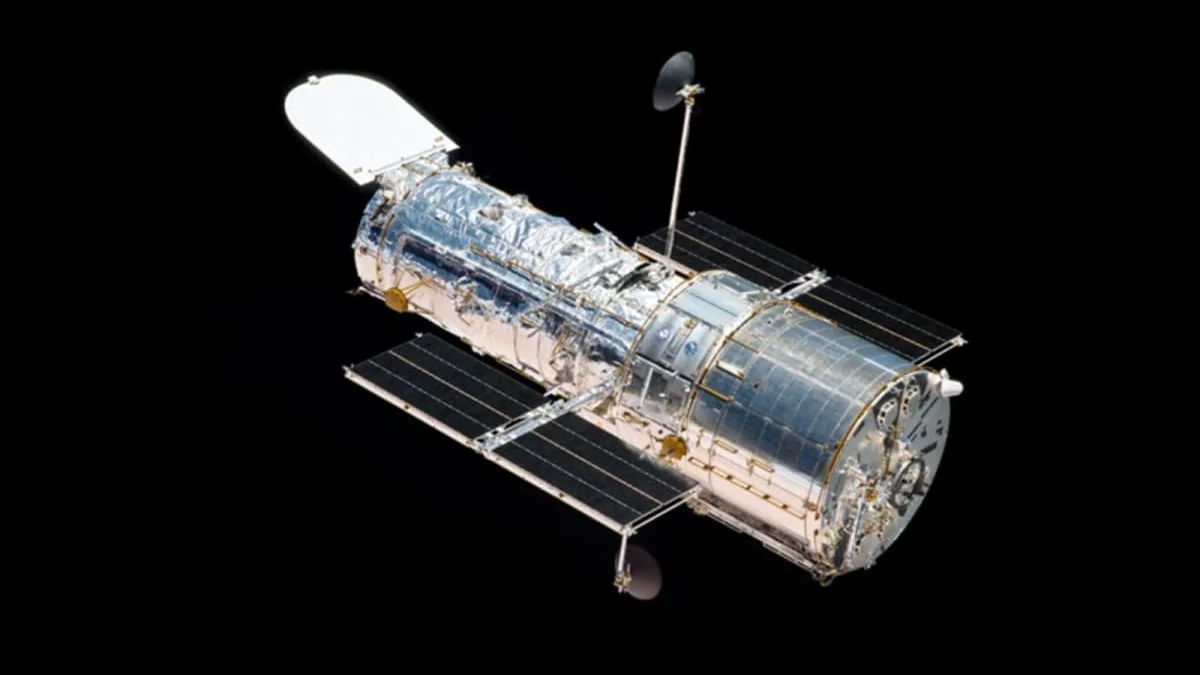
On September 19, 2026, the Hubble Space Telescope completed the 200,000th lap around our planet and thus added one more amazing episode to the life story of the observatory initially built to work only during 15 years of its service period.
Having been launched from the space shuttle Discovery in April 1990, Hubble made more than 5 billion miles, or about 8 billion kilometers, while orbiting our planet and making more than 1.7 million scientific observations in the course of 36 years.
The above achievement is only one more addition to the list of numerous milestones in the work of this old observatory, which has never stopped giving scientists the new knowledge about our universe. For example, in August 2008, Hubble completed its 100,000th orbit around Earth, and in 2011, the observatory made its one-millionth observation.
Fittingly, the 200,000th orbit coincided with an observation tied to one of Hubble's most scientific legacies: the definition of the speed at which the universe is expanding, also known as the Hubble Constant.
On the special day, the telescope took an image of MACS J0417—one of the massive clusters of galaxies that lies about 4.65 billion light-years away from our planet and located in the constellation of Eridanus—while trying to catch the next appearance of the very distant stellar explosion named Supernova Athena.
Supernova Athena has been discovered by the James Webb Space Telescope of NASA in 2025, and, as experts say, its light will reach our planet through various ways of gravitational lensing, which means that the massive cluster of MACS J0417 will bend the light from the objects located much farther.
Depending on the distribution of mass in the lensing cluster, the light can follow different ways to the observers, and, thus, the same supernova may appear several times for those who observe it, sometimes even in different years. Scientists predict that Athena will reappear somewhere between now and early March 2027, and catching the exact moment can help them find out the distribution of mass in MACS J0417.
The continued relevancy of the telescope is even more incredible when considering the problems faced that would have brought about the end of other missions in such difficult circumstances. In 2024, the telescope managed to operate under the condition that it only had a single functional gyroscope; this was a major limitation for an instrument whose main operation relies on accuracy of pointing.
This, however, did not stop the telescope from creating an image mosaic of the Andromeda Galaxy consisting of 2.5 billion pixels in 2025, marking its 35th birthday in space.
It should be noted that, unlike previously, Hubble has become a telescope that cannot be physically repaired any longer. The last mission of astronauts took place in 2009, and no plans exist for further service missions.
In spite of the emergence of additional, more advanced tools such as the James Webb Space Telescope, there is an extremely high level of demand from astronomers for time on Hubble.
As NASA reports, at present, scientists make requests for observations that are around seven times larger than the amount of time that the telescope can provide annually, owing to Hubble's distinct capability of examining light in both ultraviolet and visible wavelengths that do not overlap with the infrared tools of Webb.