
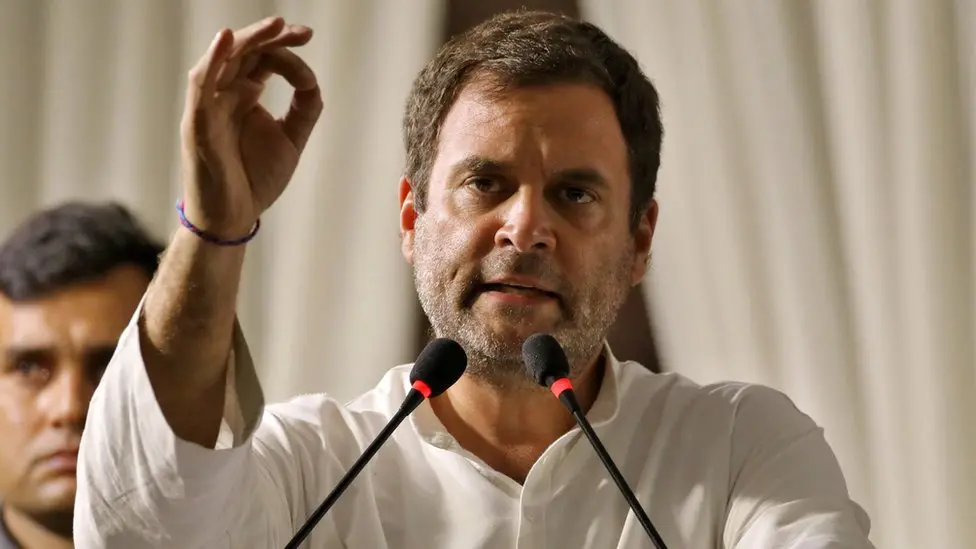
The Supreme Court cleared the slate on Wednesday morning.
A three-judge bench with Chief Justice of India Surya Kant and justices Joymalya Bagchi and V. Mohana quashed the orders of the Allahabad High Court in the Rahul Gandhi disproportionate assets case. But the judges didn't dismiss the complaint. They sent the writ petition back to High Court for a fresh hearing instead.
And those fresh hearings have stringent conditions. The Supreme Court also directed that the case be heard in open court before a fresh High Court bench. All threshold questions, including whether the petition is maintainable in law and Rahul Gandhi must be made a party and heard before any order is passed, are open.
Senior Advocate Kapil Sibal represented the Gandhi in the appeal. The top court's order is only procedural and the grievances of complainant S. Vignesh Shishir are not at all tested on merits.
The case has been dragging since May.
In May, the Allahabad High Court said two federal agencies should take action on a complaint by S. Vignesh Shishir, a Karnataka-based BJP worker, against Gandhi and his family members for alleged underreported assets. The bench said, "... if the complainant complaint has reached the CBI and ED, we expect them to verify the allegations as per law and brief this court on the progress and do such other things as permissible under law."
Several months later, on July 20, the High Court increased the heat. The judges, on perusing the status reports filed by two agencies, were not satisfied with CBI's response. Noting that "the counter affidavit filed by the agency is not in sync with our earlier order. We are not able to decipher the progress in the investigation," the judges observed. The bench directed the joint director or zonal head of the Anti-Corruption Division of the CBI at New Delhi to file a fresh affidavit in person on the investigation and noted that the ED had already proceeded and directed the record to be submitted in a sealed cover before the Senior Registrar.
A massive gap was there in the entire sequence. He had released the central agencies on Rahul Gandhi without anyone bothering to listen to him or give him a party.
Gandhi challenged the orders in the Supreme Court, which transferred the proceedings. In August, the Supreme Court issued an interim stay, halting the Allahabad High Court's proceedings and ordering the CBI and ED not to file any further charges. Wednesday's verdict is a complete reboot of that ad hoc freeze.
But Shishir's fight against the Congress leader doesn't end in this court.
The BJP worker had approached the Allahabad High Court with another petition seeking registration of FIR against Gandhi for his purported violation of the citizenship law in Uttar Pradesh. In that petition, Shishir alleges that Gandhi possessed a British passport along with an Indian one.
That case has taken a dramatic turn earlier this year. The High Court had earlier directed the police to file a FIR against Gandhi. But Shishir went to social media with the case, and that forced the judge to not only withdraw that direction but recuse himself from the matter. And the Supreme Court decision Wednesday does not go further on the citizenship petition, which is still pending with the High Court.
The Supreme Court has not defined when the new Allahabad High Court bench will hear the assets matter again.
There is also no clarity on what happens to any preliminary verification done by CBI and ED in the intervening period between the month of May and the Supreme Court's freeze in August. With all earlier High Court orders being nullified, there is no judicial mandate for either agency to report back now, and Gandhi's lawyers are bound to question Shishir's standing and the maintainability of the petition as soon as the new bench meets.
The documents and status reports submitted to the High Court in July by the CBI and the ED in a sealed cover remain under wraps. And Gandhi says it isn't, actually, and Shishir's is just a "review" of her plea in another case to be tried for disproportionate assets. The disproportionate-assets charge will get you nowhere only when (and if) a fresh bench considers Gandhi's case in open court and sees whether even Shishir's plea can clear a first legal hurdle: an ever-burden of proof that is as non-existent as it was the day it began.










Comments 0