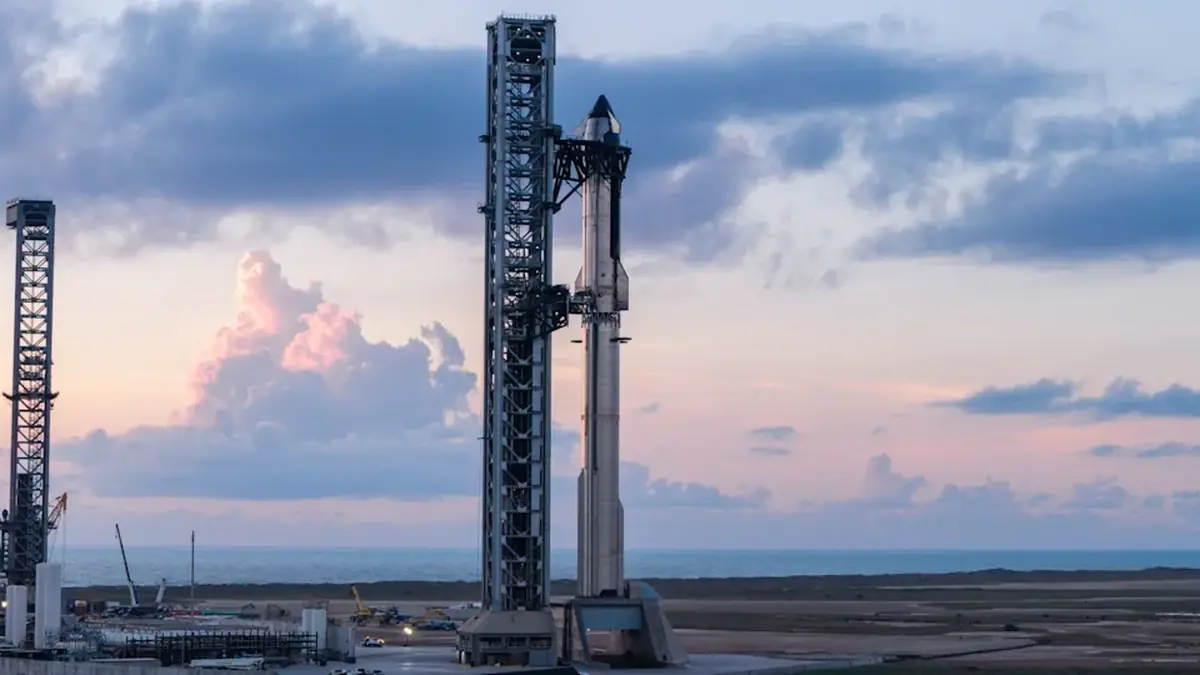
According to SpaceX, Starship Flight 14 has been confirmed to have a launch date no earlier than Monday, September 28, 2026. SpaceX says the upcoming launch attempt is one of the most daring and crucial in the history of the Starship. It will be possible to launch within a 75-minute window starting from 8:15 a.m. EDT (1215 UTC) from Pad 2, Starbase, in Texas, USA.
The mission will comprise Booster 21, which is a Version 3 Super Heavy rocket booster prototype, and Ship 41, the corresponding version three Starship upper-stage spacecraft. The rocket had already been towed to the launchpad on September 20 in the evening, while the starship was loaded onto the rocket right after that. On September 24, the wet dress rehearsal was conducted by the rocket.
Whereas other Starship test launches have been known to launch either a mass simulator or just one or two prototype satellites in suborbital flights, Flight 14 is set up to send the starship into real orbit around Earth at an altitude of about 275 kilometers.
The idea is that the starship will complete about six orbits around Earth in nine hours before performing a deorbit maneuver.
During that extended orbital coast, Ship 41 is expected to deploy 26 upgraded Starlink V3 satellites, marking the first deployment of the new satellite generation into what SpaceX has designated Starlink Group 31-1.
Three of the satellites will have modified camera systems onboard, designed to image the heat shield of Ship 41 while in spaceflight. This will provide engineers at SpaceX with data about how well the thermal protection system of the spacecraft performs when it is reentering the Earth's atmosphere from space.
It should be noted that on this flight, the company does not plan a catch of Booster 21 on the tower, opting instead for a controlled landing of the Super Heavy stage offshore.
While the target date for the launch is set for September 28, the exact timing of the flight will still be determined by FAA clearance. Due to the changed nature of the flight itself, with Ship 41 entering orbit and coasting for almost 8 hours prior to landing after almost 9 and a half hours into the flight, SpaceX had to obtain a modification of their existing launch license.
However, as of the most recent information, it was not clear if it will arrive in time for the September 28 deadline, even though the FAA's announcements related to the mission stretch until October 4.
The flight had already been delayed from its original launch window of September 18 and then again from September 22 before finally locking onto the September 28 date, which was still contingent upon that final regulatory approval.
This flight is important not only on its own merits but also because SpaceX sees an orbital attempt as the stepping stone to even bolder aspirations. In the event that this flight succeeds, Flight 15 will be SpaceX’s first realistic chance to attempt a ship catch at the launch site, while in the best-case scenario, a double ship catch between the booster and the ship could also become a reality.
On the other hand, SpaceX is planning on making Flight 16 the first time a Starship launches from NASA’s historic Launch Complex 39A at Kennedy Space Center, Florida, based on reports from workers at the Florida spaceport.
Its last two test flights, one by Ship 39 and another by Ship 40, managed to complete their respective suborbital flights and splashed down in the Indian Ocean, with Ship 40 surviving its ocean entry and is currently on its way to Starbase via a recovery boat for analysis.