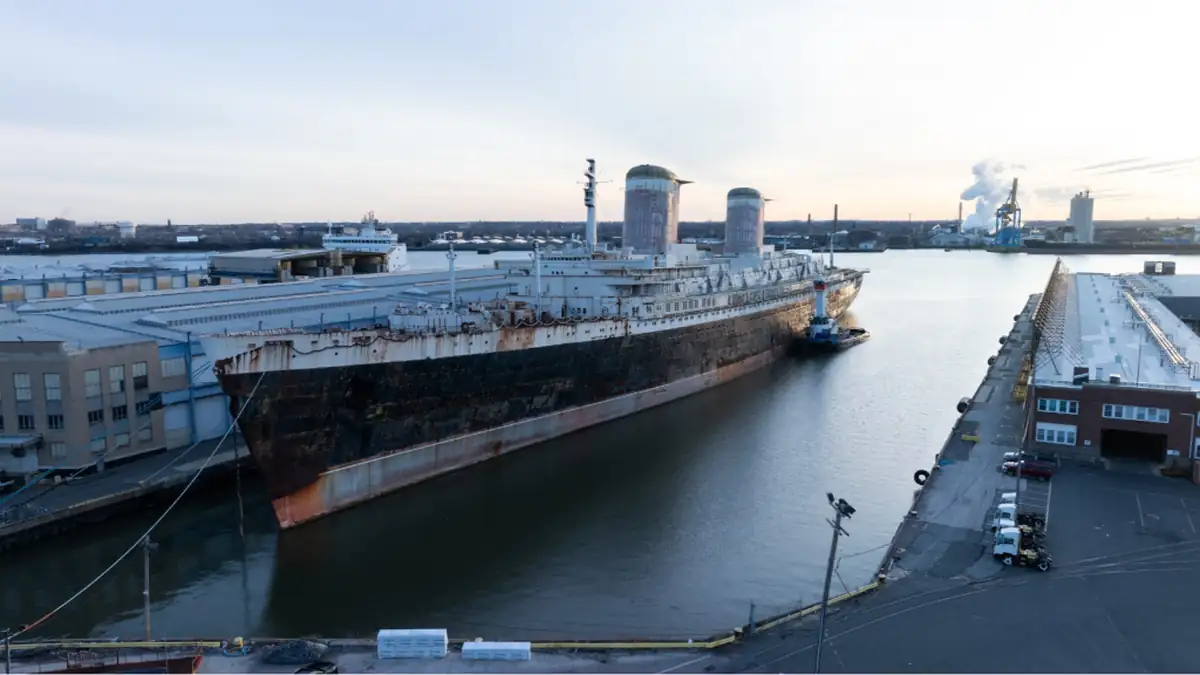
The SS United States finally went under around 9 p.m. Wednesday, several hours after the sinking began on a cloudy afternoon in the Gulf of Mexico. Organizers had said it could be done in an hour. By nightfall most of the ship was still sitting above the waterline off the Florida Panhandle, and then it leaned over on one side and dropped out of sight quickly.
It is now the biggest artificial reef anywhere. Okaloosa County, which bought the vessel and ran the operation, says the whole project cost $13.5 million.
Coleen O'Malley, president of Coleen Marine, the company that carried out the sinking, said before the ship disappeared that it was "an amazing lady who will not lay down without a fight."
The more practical reason was water. Crews had to flood 128 fuel and lubricant tanks so the hull would come to rest level on the bottom, and a county spokesperson, Nick Tomecek, said that took longer than anyone planned for. Officials had also pulled the date forward by a day because of weather concerns. It was originally set for Thursday.
No explosives were used. Federal environmental and explosives rules ruled them out, so the preparation was done by hand. The intake pipes that once fed seawater to the boilers were opened, their tanks taken out, and the valves turned to let the hull fill. Workers cut 10-foot-square holes in the decks and removed more than 400 portholes. The two 65-foot funnels were taken off earlier to be used in a museum.
About 25 miles southwest of Destin, between Panama City and Pensacola. The water is around 180 feet deep and the top deck ends up roughly 60 feet down, which means divers without a lot of experience can get to it.
The liner is 108 feet longer than the Titanic. More than 3,000 people built it in Virginia over 1950 and 1951, and on its maiden voyage in 1952 it crossed the Atlantic at an average of nearly 41 mph, which beat the Queen Mary's 1938 mark by 4.5 mph. There was a gale at the end of that trip, 69 mph by the AP's account. An AP reporter was on board with Margaret Truman and about 1,700 other passengers.
Over the years it made the crossing more than 800 times. The passenger list included Grace Kelly, Elizabeth Taylor, Presidents Truman, Eisenhower and Kennedy, and Britain's former King Edward VIII, and a young Bill Clinton took it in 1968 when he headed to Oxford. Menus ran to caviar, roast duckling and smoked ox tongue.
The ship was decommissioned in 1969. A hotel magnate and Norwegian Cruise Line each had ideas for it that went nowhere, and from 1996 it was tied up at a dock in Philadelphia.
The end came out of a rent fight. The owner of the Philadelphia pier and the SS United States Conservancy fell out over what the Conservancy owed, and that eventually forced the Conservancy to sell. Okaloosa County bought the ship in October 2024 to use as a reef, and tugs towed it out of Philadelphia in February 2025 to Mobile, Alabama, where it was cleaned up.
People kept trying to stop it. A coalition from New York sued earlier this year and lost. Then, days before the ship left for the reef site, the SS United States Preservation Foundation went to federal court and argued the sinking could put toxic material into Gulf waters and the seafood supply. The judge denied its emergency request on Friday, Nov. 6, and wrote that the group had not reckoned with the substantial cost of berthing, mooring and docking a vessel this big. The foundation filed again. The county said it was staying on schedule, and it did.
Divers may be able to reach the wreck as early as Friday, once a 24-hour safety wait is over. The county wants divers and anglers, and expects tuna, marlin and swordfish to settle around the ship. More than 500 artificial reefs already sit in these waters. The Oriskany, sunk in 2006 off Pensacola, is close enough that an experienced diver could visit both wrecks in one day, according to Tomecek.
Researchers from Woods Hole Oceanographic Institution, Dauphin Island Sea Lab and Louisiana State University will monitor the biology, physical conditions and chemistry around the site. The Conservancy is planning a land-based museum for artifacts, furnishings and archive material, and the funnels are meant to anchor it. Susan Gibbs, granddaughter of the ship's designer, said she was glad parts of the liner could be kept.