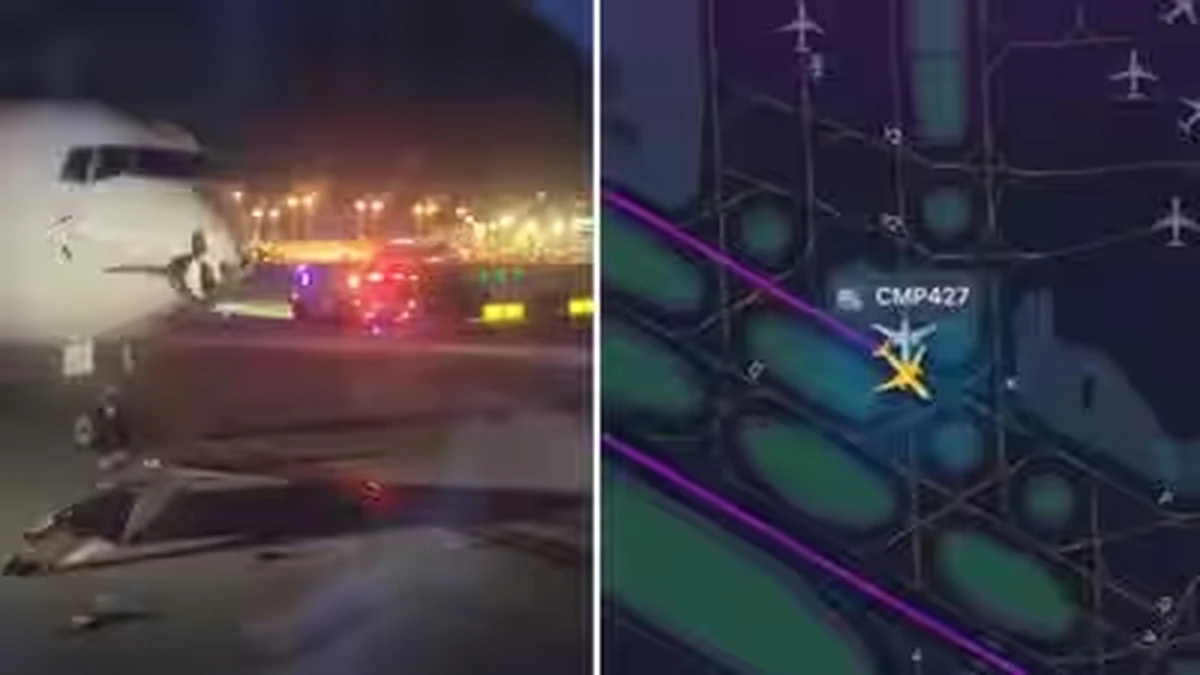
A UPS cargo jet and a Copa Airlines passenger plane hit each other on the ground at Miami International on Saturday night. Nobody was badly hurt. The recording of what happened next is the part people can't stop sharing.
"427, somebody hit us."
That's the Copa pilot, flight CM427, a 737-800 that had just come in from Panama City with 166 passengers and six crew. He sounds more irritated than rattled.
Miami-Dade Aviation Department spokesman Greg Chin put the time at about 9:15 p.m. An arriving aircraft and a departing one, he said, "made contact with each other at the intersection of two taxiways."
The arriving one was the Copa. The departing one was UPS flight 5X358, a Boeing 767-300 on its way to Bogotá.
According to the FAA, the 737's wingtip caught the nose of the 767. Photos from the scene show the freighter's nose crumpled and damage to the Copa's left wingtip. Neither aircraft was going fast, which is probably the only reason this is a story about bruises and not something worse.
Two passengers reported minor injuries, back pain according to aviation outlets, and Miami-Dade Fire Rescue treated them where they stood. All 166 passengers got off at the terminal.
After the Copa pilot's call, the controller turned to the other aircraft. UPS, he said, was supposed to give way to the 737.
The UPS pilot's reply: they were running a checklist, there'd been a runway change.
Then the controller asked it plainly. UPS 358, did you hit that aircraft?
"Yeah, we went too far," the pilot said, "and he clipped us with his wing."
Worth being careful here. That's one pilot's account in the first minute after impact, not a finding, and the investigation could land somewhere else entirely. But a late runway change is a real pressure point. It means new numbers, a new briefing and a pile of checklist items, all while the aircraft is still rolling around an airfield at night.
Not yet. The FAA has only said it's investigating, and the audio points one way without settling it.
Copa's statement said the 737's left wingtip was involved and that everyone left the aircraft at the terminal. UPS acknowledged the incident on X. "Our crew is safe," it said, adding that it would work with authorities to establish what happened.
Both planes are going to be out of service for a while. A crushed nose on a 767 isn't a quick fix, and neither is a wingtip.
Friday was the nationwide FAA ground stop. Radar and communications systems wobbled, thousands of flights got disrupted, and Transportation Secretary Sean Duffy spent Saturday saying air traffic control communications were back to full operations. FAA Administrator Bryan Bedford said airlines expected to restore full schedules by the end of Sunday.
So when two planes met on a Miami taxiway roughly a day later, people made the connection immediately. Nothing reported so far supports one. The ground stop was about radar and comms equipment. This looks, going by the audio, like a mistake on the ground by a crew.
Still. You can see why it spread.
Miami International has had a run of these.
On November 5, a Lufthansa 747-8 bound for Frankfurt had to stop at full taxi speed when an American Airlines 787, fresh in from Philadelphia, turned into its path after being told to give way to it. The Lufthansa pilot said he'd file a report and called it very close to an accident in the making.
Earlier, an Amazon cargo jet overran a runway there and struck vehicles in a crash that killed people and set off a huge emergency response. The NTSB has already put out preliminary findings on that one.
Three different events, three different causes. Regulators will look at all of them anyway.
The usual. Pull the air traffic control recordings, the ground radar tracks, flight data and crew statements. Work out where exactly the UPS jet stopped relative to where it should have, and what it had been cleared to do.
Passengers connecting through Miami should check with their airlines, since the wider recovery from Friday's shutdown is still being worked through. The airport itself says taxiing traffic was simply routed around the collision site and it's not seeing operational impact.