
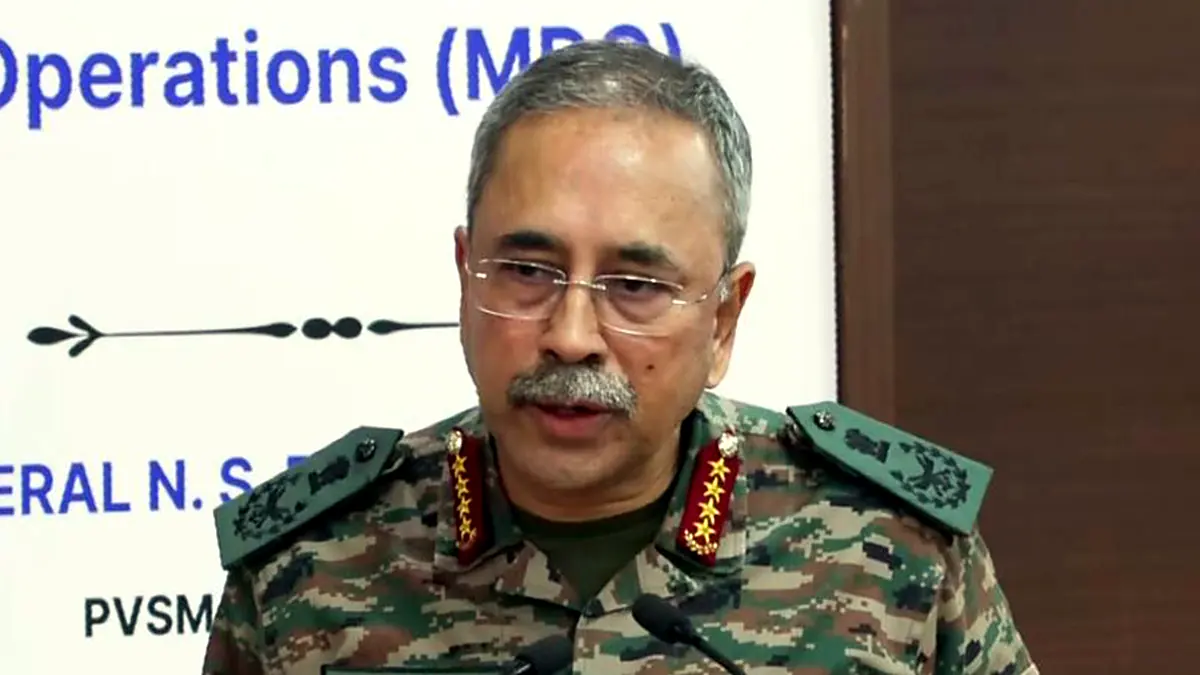
The question was regarding a Pakistani astronaut. However, the answer was on satellites, espionage and how India would fight its next war.
"Pakistan's space capability, which is improving thanks to China, has to be 'factored into our calculus','' General N.S. Rajan Subramani, Chief of Defence Staff said Friday, 27 November, as reported by PTI. This was his address at Vivekananda International Foundation in New Delhi, regarding the future of warfare and India's preparations for multi-domain operations."
The incident was sparked by a launch. The statements were made after Muhammad Zeeshan Ali, a pilot in the Pakistan Air Force, became the first foreign astronaut to be launched on board the Chinese Shenzhou-24 craft for the Tiangong Space Station.
This project is being undertaken to commemorate the 75th anniversary of diplomatic relations between China and Pakistan, which are described as "all-weather" allies with strong defense and financial connections.
But this CDS transcended that of an astronaut. "Whatever capability China possesses in terms of ISR, positioning, navigation, timing, etc., Pakistan will have and we will have to take it into account in our calculations," he stated.
ISR refers to intelligence, surveillance, and reconnaissance. The CDS also pointed out that Pakistan’s national space agency, SUPARCO, is developing its own capabilities.
He mentioned another partner too. “So now, it also needs to be taken for granted that this will receive assistance from Turkey,” he said.
These statements become even more important in light of Pakistan’s military partnership with China and Turkey, which gained prominence in the course of operation Sindoor conducted last year.
The CDS referred to the program saying, "With the arrival of Space-Based Surveillance Phase-III (SBS-3), there is going to be a major increase in our capability," and further stated that India is also developing its capability to launch more satellites with the participation of the private sector.
None of the reports discussed gave any details regarding cost, time frame or number of satellites.
The second message was related to speed. “I can assure you that it is not that we do not have the money but that we must, I believe, speed up our processes,” he said. If the processes are fast tracked, then India will have sufficient financial resources not only to be able to compete with Pakistan, but to beat it, as well as narrow the gap with China.
The other issue was of procurement status. The defence procurement process has been revamped, and there is a need for revamping of the Defence Acquisition Process, which is pending with the PMO.
The speech had a more far-reaching message. According to Gen Subramani, technology and warfare are constantly changing; therefore, technological superiority is only temporary and will require improvements in order to remain ready for future battles.
He also explained that multi-domain operations are not about using all capabilities together but integrating various capabilities to create various dilemmas for the adversary.
A news channel also added its perspective. WION reported that China is developing its capabilities in space at a rapid pace and is soon expected to be capable of disabling or knocking out satellites. This is a perspective of the news channel, and not of the CDS.
However, one can hardly say that Pakistan has no practice in using Chinese space technologies. The evidence of such practice is the use of the Paksat-1R satellite communications spacecraft developed by China Great Wall Industry Corporation and managed by SUPARCO.
Such information proves to what extent Pakistan relies on Chinese suppliers of space technologies. However, the above-listed resources do not reflect all the assistance and development of space technologies in Pakistan.
Opinion about the direction had been made available to him via the CDS. However, no details about the systems of Chinese or Turkish origin were given nor names of satellites of Pakistan and also whether they share any capability for use against India.
These words convey the opinion about the intention and availability within the assumption of planning. The word "will be available" is a prediction and not possession of capabilities.
Satellite sensors aid missiles by offering services of targeting, early warning, and communication.Having the neighboring nation be more sophisticated in terms of imagery and navigation will enable targeting of enemy positions quicker. This is the reason why satellite sensors have been considered as part of the battlegrounds and not something separate from the battlegrounds.
The sources reviewed did not offer any comparisons between Indian satellites and satellites belonging to Pakistan or China.










Comments 0