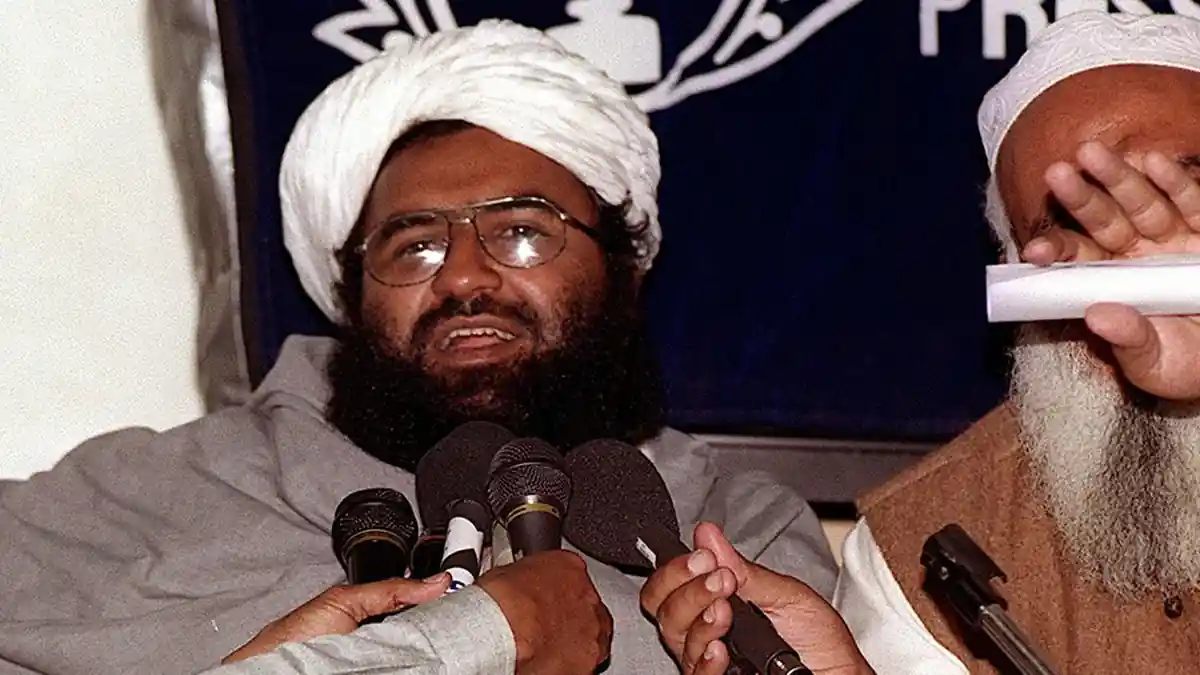
The Red Book of most wanted terrorists for the year 2026 was issued by Pakistan's Federal Investigation Agency (FIA) on Monday, September 14. The book names JeM head Masood Azhar as an absconder, along with an increased reward of PKR 20 lakh to reach PKR 70 lakh.
This decision has been termed by Indian analysts as just a "smokescreen." It is believed that the timing of the announcement has been deliberate so as to affect FATF, the global agency tracking terror finance, before its plenary meeting in October.
As per the recently released list by the FIA, Azhar has been officially declared a fugitive, with the amount of reward money offered on his arrest increased to PKR 70 lakhs.
This is not the first time that Pakistan has done this. In 2021, FIA had put a reward of PKR 50 lakhs on him while also claiming that he had left Pakistan and moved to Afghanistan.
The total number of the most wanted terrorists mentioned in FIA’s Red Book has increased by 35% in the last five years, rising from 1,330 in 2021 to 1,804 in the latest list.
The Indian intelligence sources dismissed Pakistan's assertions that Azhar has taken refuge in Afghanistan, stating that he is still in Pakistan. "The listing of Azhar by the FIA is nothing but eyewash meant to mislead the world," sources said in several media reports.
In their opinion, the increase in the bounty was aimed at making people believe that Azhar was being pursued in Pakistan, and the actual location of the terrorist remained under wraps from the international community's eyes.
Commenting on the developments, a defense expert said, "It’s largely a smokescreen Pakistan has created to shield itself from the scrutiny of the Financial Action Task Force," referring to the FATF meeting held in October.
The Indian officials have not just challenged the Pakistani claims with regard to Afghanistan but have also stated that their surveillance indicates the movement of Azhar across certain sites within Pakistan.
As per one report, the officials said that Azham is generally housed in a location at Nawabshah city in the Sindh province and a separate safe house at Skardu in Pakistan Occupied Kashmir (PoK). Azhar is now said to be shuffled between Nawabshah and Rawalpindi.
The safe house at PoK comes as that area faces persistent unrest, as reported by some media houses, and therefore, has led to the shifting of focus of recruitment of Lashkar-e-Taiba and Jaish-e-Mohammed from PoK towards other parts of Pakistan, as stated by the Indian officials.
The Indian officials also stated that Azham continues to motivate the JeM members via audio messages encouraging them to stick to their mission against the Indian security forces in Jammu and Kashmir.
The Pakistani government’s assertion that Azhar is hiding out in Afghanistan has also been dismissed in the past by the Afghan Taliban, reported sources.
An official pointed out the impossibility of such an act taking place due to the existing tensions between the two groups when saying, “With the tensions with the Taliban running so high, there is no way that Pakistan could move him into Afghanistan.”
Azhar’s group has already faced direct attention from India before. According to some sources, the headquarters of JeM in Bahawalpur called Markaz Subhanallah became one of the facilities that were destroyed in the operation Sindoor conducted by India.
This building that operates in Pakistan about 100 kilometers from the border since 2015 and became the training base for JeM, was associated with the preparation of attacks in February 2019 in Pulwama where 40 CRPF soldiers were killed.
It is believed that the building contained also residences for Azhar, for Mufti Abdul Rauf Asghar – the leader of JeM, as well as the place where speeches were held and Azhar was calling youth to support his cause.
Much of the doubt surrounding the announcement from Pakistan has to do with the timing involved. The FATF will hold its plenary session in October, while previously Pakistan has been known to have spent time on the grey list due to its failure to take action to stop the financing of terrorism.
According to the quoted defense analyst, the release of the Red Book by Pakistan aims to make Pakistan look like a "good boy" in the eyes of the international community, UN, and US.
It is anticipated that the upcoming October FATF plenary will mark the next significant instance of international scrutiny of Pakistan's response to terror funding, such as its approach to individuals like Azhar.
What impact the new reward policy of Pakistan has on that evaluation, or whether India's dismissal of the same as a "smokescreen" holds sway with FATF members, remains to be seen.