Zuckerberg didn't hold anything back this year.
At Meta Connect 2026, the company unveiled a genuinely wide spread of hardware in one sitting: new Ray-Ban Meta Audio glasses that drop the camera entirely, a fresh Ray-Ban Meta Gen 3 lineup, a $1,299 VR headset built to look and feel nothing like a headset, and a small pocket sized AI companion called Muse Charm. That's four products, four different price points, four different bets on how people are actually going to want AI in their lives once it's not just an app on a phone.
Start with the one that's getting the most attention for a slightly awkward reason. Meta's Ray-Ban glasses have carried an unfortunate nickname for a while now, "pervert glasses," a label that stuck after privacy concerns around the built-in camera never fully went away. The new Ray-Ban Meta Audio glasses are Meta's answer to that, and the answer is simple: take the camera out entirely.
What's left is built-in audio, up to 12 hours of battery life, and customizable physical controls, wrapped in the same Wayfarer and Aviator shapes people already recognize. They go up for preorder now and ship October 13. Whether removing the camera actually repairs the reputation those glasses picked up is a separate question, and it's one journalists covering the announcement seem genuinely split on. A camera-free pair solves the recording concern. It doesn't necessarily solve the broader unease people have developed around wearing a camera adjacent device on their face, even when the lens isn't there anymore.
Alongside the audio only model, Meta also refreshed the standard Ray-Ban Meta Gen 3 line, expanding into a new Zena style for the first time and adding a limited edition Aviator variant. If the audio glasses are the privacy conscious option, Gen 3 is clearly still the flagship, camera included, for people who never had a problem with the concept in the first place.
The VR side of the announcement took a different approach entirely. Meta's new VR Glasses are priced at $1,299 and weigh around 100 grams, a number that only makes sense once you learn where the rest of the weight went. The battery and the actual computing hardware live in a separate wired pocket device, not on your face. Everything sitting on your head is just the display and optics.
That's a meaningful design decision, not a cosmetic one. Comparisons to Apple's Vision Pro have already started circulating, with some early hands-on coverage describing Meta's headset as roughly 83% lighter and 60% smaller than Apple's device. One tech commentator put it plainly on social media: moving weight off your face might matter more for everyday comfort than another bump in screen resolution. That's a fair point, and it's also clearly the exact argument Meta is making with this product, packaged as something you could use for 3D cinema, watching live sports, or working, without it feeling like a helmet.
Here's the announcement that seems to have caught people slightly off guard. Muse Charm is a small, palm sized device, described by more than one outlet as something like a Tamagotchi for Meta's Muse AI agent, small enough to clip onto a keychain.
The idea is that not every interaction with an AI assistant needs to happen through glasses on your face or an app on your phone. Sometimes you just want to talk to something small in your hand or your pocket. Reactions have been mixed, somewhere between charmed and confused, which is probably exactly the reaction a genuinely new hardware category tends to get in its first week.
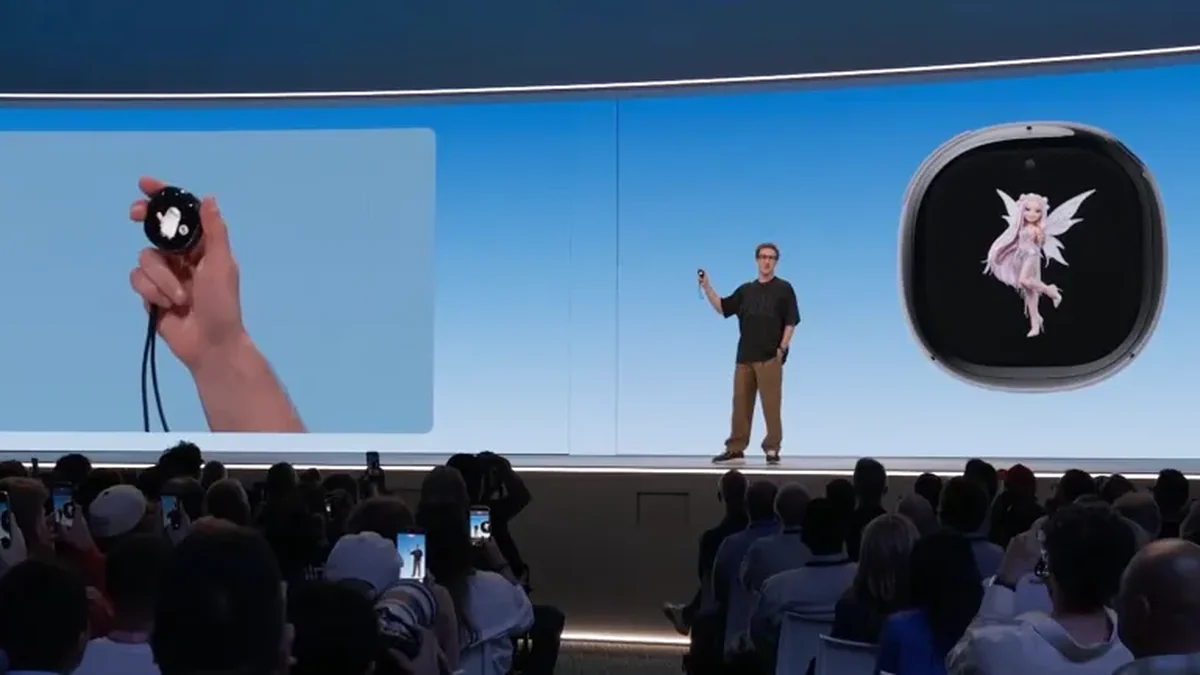
Photo: Meta
None of these products exist in isolation. Together they read like Meta trying to cover every physical form factor a person might reasonably want AI to live in: face, pocket, keychain, living room. Andrew Bosworth and the rest of Meta's hardware leadership have been fairly open about the strategy behind this, positioning the company ahead of both OpenAI and Google in actually shipping consumer AI hardware, rather than just talking about it.
There's also a privacy story running underneath all of it. Meta has been working to reassure users their data is handled responsibly, including a technical push the company calls Private Processing, aimed specifically at addressing the concerns that have followed its camera equipped glasses since launch. Whether that messaging actually lands with a public that's already skeptical is going to take longer than one keynote to find out.