
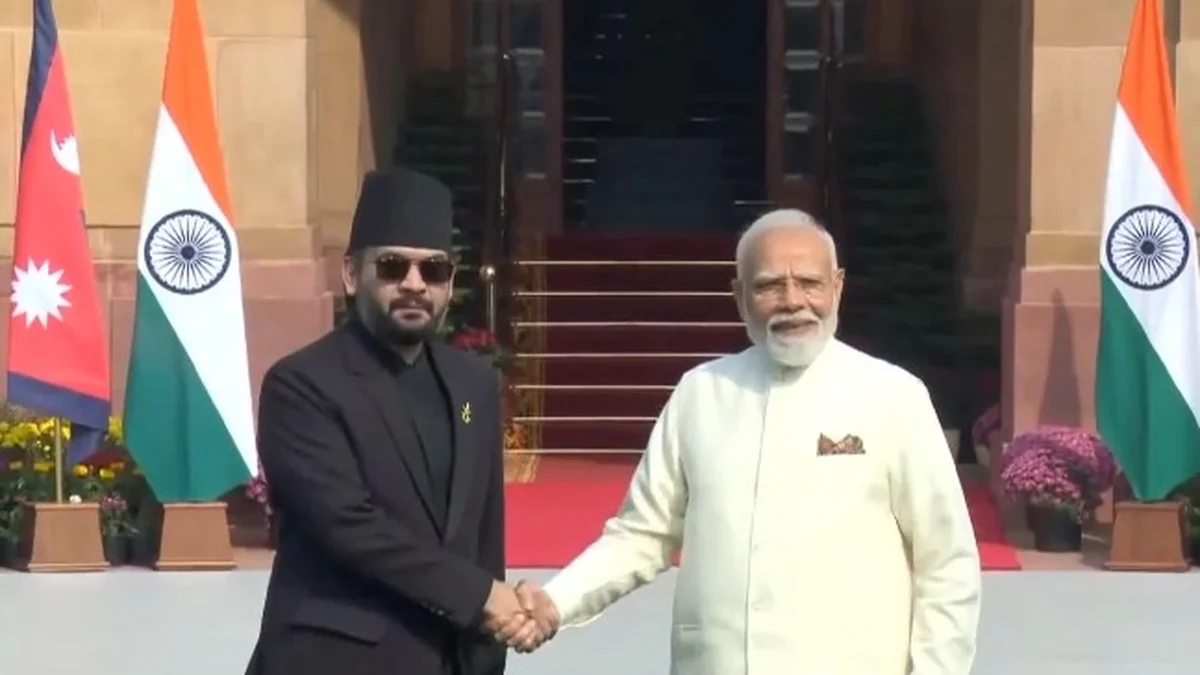
Balendra Shah, better known to most Nepalis as Balen, arrived in New Delhi on Sunday on a state visit cut to about 25 hours. The trip had been initially scheduled for three days, earlier reports said.
Sunday evening was a meeting with the External Affairs Minister S Jaishankar. Monday began early with a ceremonial welcome at Rashtrapati Bhavan, a call on President Droupadi Murmu, a wreath at Raj Ghat for Mahatma Gandhi, then Hyderabad House.
The one-on-one with Modi started at around 1115 GMT. This was followed by delegation level talks with Nepal’s Foreign Minister Shishir Khanal and Finance Minister Swarnim Wagle in the room.
The two leaders also exchanged gifts. Modi gave Gangajal from Triveni and Nepal returned with rudraksh and chandan from Pashupatinath.
That was the lead story. The deadly floods in Nepal in August were a matter of concern," Modi said at the joint press meet where he stood next to Shah and offered condolences. ""Today, we are announcing a Development Cooperation Package of 24,000 crore Nepali rupees to give new strength to Nepal's reconstruction and long term development," he said.
Nepali and Indian media had reported prior to the visit that Kathmandu was seeking some $2 billion in grants and credit of which about $1 billion would be in grants. The package announced is in Nepali rupees and early coverage did not spell out the breakdown between grants and loans. That detail will be important when the paperwork arrives.
Modi’s pitch was to get affected families “back on track” and to strengthen Nepal’s capacity to cope with the next disaster.
The signing list was broader than the usual aid-and-roads stuff.
ISRO and Nepal’s communications ministry agreed to set up a satellite communication network with the help of the South Asia Satellite. Two pacts were signed regarding standardized policing, which included an agreement between National Forensic Sciences University at Gandhinagar and Crime Investigation Department of Nepal Police and another between Rashtriya Raksha University and National Police Academy of Nepal.
And there is a civil service training program, a health cooperation MoU, a government-to-government agreement on Ayurveda and traditional medicine and pacts on sustainable urban development and on livestock and fisheries.
After the talks, the two prime ministers launched a series of virtual products.
The Saryu-Kamala Express links Ayodhya Cantt with Janakpur Dham, two towns with connections to the Ramayana. It will travel some 604 km in about 19 hours, with regular weekly services starting Nov. 28.
A new motorable bridge between Dharchula in India and Darchula in Nepal was inaugurated. Leaders laid foundation stone of an Integrated Check Post at Banbasa and reviewed progress of check posts at Bhairahawa, Sunauli and Dodhara Chandani.
On Energy, they laid the foundation stone of the 669 MW Lower Arun Hydroelectric Project. Phase II of the Motihari-Amlekhgunj petroleum pipeline and a petroleum terminal at Jhapa, which is part of a proposed Siliguri-Jhapa pipeline, were also commissioned.
Some of the most sensitive files never reached the formal agenda.
The border dispute involving Lipulekh, Kalapani and Limpiyadhura would not be on the agenda, Nepali outlets had reported before the visit. Same is the case with Gurkha recruitment to Indian Army and the report of Eminent Persons Group. Nepal claims the disputed areas but India’s stand is that they belong to Uttarakhand. The early coverage Monday showed no sign of that change.
The other open question is air routes. For long Nepal has been keen to open up more points of entry into its airspace through Indian territory with Bhairahawa, Nepalgunj, Mahendranagar and Janakpur on its wish list. Before the talks officials on the Nepali side said India was leaning positive on lower altitude routes but wanted a full package agreement and no deal had been settled. So far, neither side has announced one in the coverage seen.
A few months ago, relations were not good. Indian media said Shah, a rapper-turned-politician who became prime minister in March on a mandate Modi labeled the hopes of Nepal’s new generation, ruffled Delhi by suggesting China and the United Kingdom could be brought in to help settle the border question.
Lipulekh has been a sore spot for years, and Nepal has previously objected to the pass, something that has been rejected by Delhi.
So Monday’s language was deliberately warm. Modi described the relationship as one of “close kinship and unbreakable trust” and praised Shah’s vision. He noted Shah had addressed the United Nations as the world’s youngest prime minister.
There aren't cheers from everybody back home. The main opposition, the Nepali Congress, wished Shah well but complained that it was not consulted beforehand on the trip.
Saryu-Kamala Express to start regular service in five days The package will require a breakdown, and Kathmandu will want to know how much comes as grants. The air-route question remains open and a joint vision document on trade, energy, transit, health and digital links was said to be in the pipeline.




Comments 0