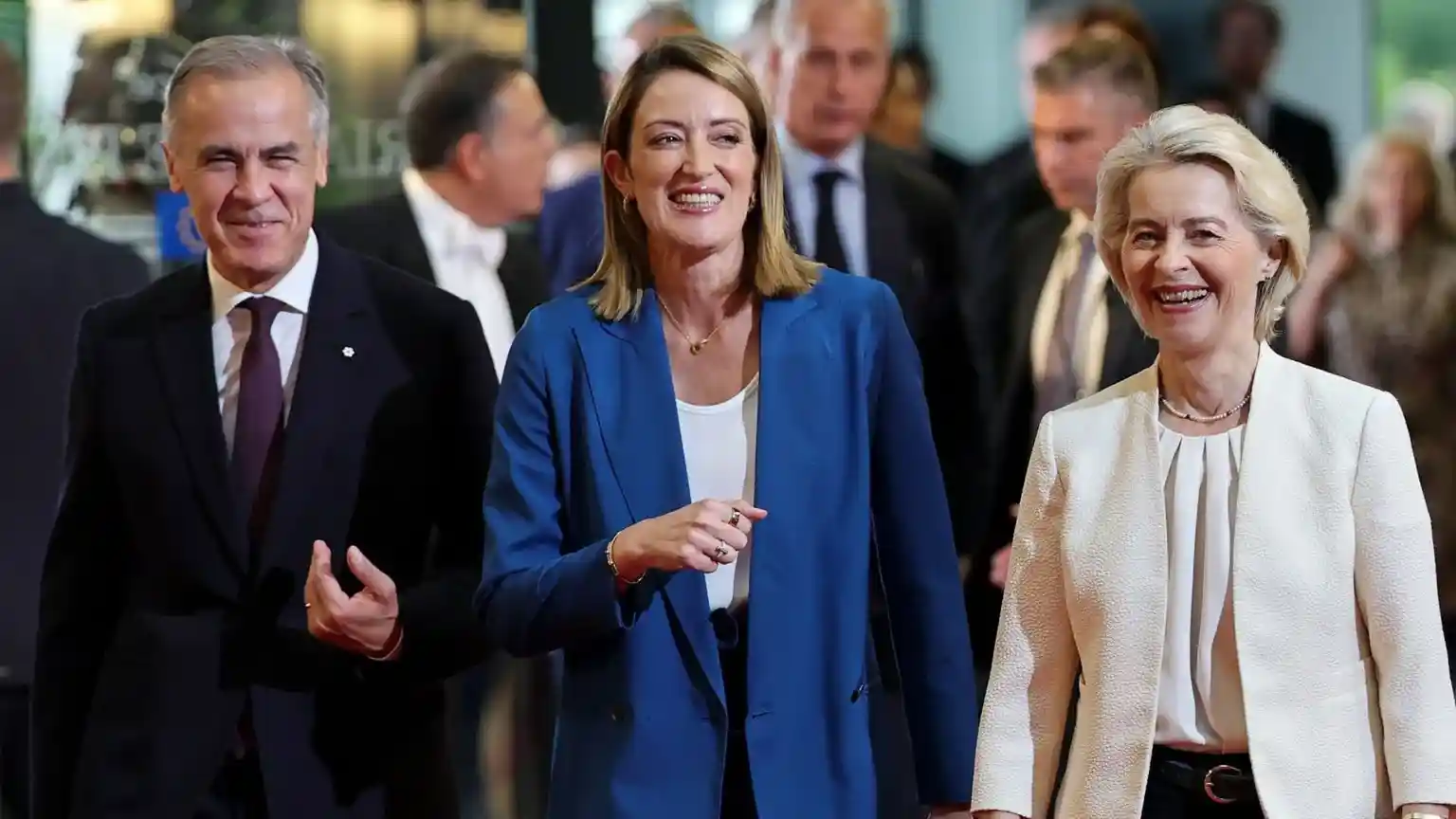
Ursula von der Leyen was about forty minutes into her annual State of the Union address in Strasbourg when she turned, mid-sentence, to a man sitting in the gallery.
"Dear Mark," she said, "I would like to work with you on opening the door for Canada to being the first associate member of the European Union."
Mark Carney stood up. He walked to the podium, embraced her, kissed her on both cheeks. The chamber gave a standing ovation. He is due to address the full Parliament on Thursday.
It is the kind of moment that looks staged in hindsight and probably was, at least partly. But the substance underneath it is real, and it is new. Associate membership does not currently exist anywhere in EU treaty law. Nobody has ever held it. If this goes anywhere, Canada would be the first.
Von der Leyen framed it as part of a bigger theme, one she returned to several times in the speech: partnerships as "a strategic choice for Europe" in response to what she called a fracture in the international rules-based system. "We see the world with the same eyes," she told MEPs, "from AI to climate change, from the Arctic to geopolitics."
She listed the things Brussels and Ottawa already stand together on. Ukraine. Defence. Raw materials and supply chains. Then the bigger claim: "Above all, Europe and Canada believe in democracy."
The word "highest" did a lot of work in her phrasing. She wants to bring the relationship, in her words, to the highest level possible. Nobody in the chamber needed the subtext explained. Donald Trump's tariffs on Canadian goods, and his repeated musing about Canada becoming the 51st American state, have been public for months now. Von der Leyen was not being subtle about who this speech was aimed past Carney and toward.
Here's the part that makes the applause a bit more interesting. On Sunday, at a film festival event in Toronto of all places, a reporter asked Carney about a Wall Street Journal report claiming he'd instructed an envoy to explore the most ambitious relationship possible with the EU, short of full membership.
His answer, at the time, was closer to a denial than a confirmation.
"We're not looking to become a member of the European Union," he said. What he wanted, he said, was a "unique alliance." Different phrase. Deliberately vaguer. The Globe and Mail reported separately that it was actually the EU side, not Ottawa, that had floated the associate membership label first, and that any talk of an actual title was premature.
Three days later, the label was announced from the podium in Strasbourg, by von der Leyen herself, with Carney a few metres away.
Associate membership isn't a brand new idea. German Chancellor Friedrich Merz raised it in May for a completely different country: Ukraine. His pitch then was a seat at summit and ministerial tables without voting rights, protection under the EU's mutual assistance clause, and access to EU funding programmes.
That proposal went nowhere fast. Member states were, at best, lukewarm.
Which raises an obvious question hanging over Wednesday's announcement. If the bloc couldn't get behind associate status for a country fighting a war on its border, will 27 governments actually agree to invent the category for the first time and hand it to Canada instead?
One MEP put a sharper version of that question on the record almost immediately. Nicola Procaccini, from Giorgia Meloni's Brothers of Italy, asked why the United Kingdom wasn't first in line if the EU was suddenly in the business of creating associate memberships. It's a fair jab. The UK left the bloc five years ago and has spent much of that time trying to patch the relationship back together, piece by piece, without anything close to this kind of red-carpet offer.
There's a practical reason to be skeptical this moves quickly, and it has nothing to do with politics. Canada and the EU already have a trade deal, CETA, signed a decade ago in 2016. It still isn't fully ratified. Ten member states haven't gotten it through their own parliaments, partly over lingering objections from farm lobbies worried about Canadian agricultural imports competing with theirs.
If a straightforward trade agreement can stall for ten years, an entirely new membership category invented from scratch, needing unanimous approval from all 27 capitals, is not going to happen on any kind of fast timeline. The EU's own website describes the association agreements it already has, more than 20 of them with various countries, as a flexible framework for varying degrees of cooperation. Negotiating them, it notes, typically takes years.
Not everyone in Canada is thrilled about any of this. Opposition leader Pierre Poilievre used the earlier WSJ report to go after Carney hard, accusing him of negotiating in secret while, in Poilievre's telling, Canadians were skipping meals and mortgage payments. He wrote on social media that Canada would "NEVER be the 28th EU state," pairing it with his more familiar line about never being the 51st American one either.
Polling tells a different story about the general public, though. A survey released a few days before the speech found roughly four in five Canadians support closer integration with the EU. Whatever Poilievre's objection is, it doesn't appear to be a majority position at the moment.
For now, what exists is a proposal from one EU institution's leader, offered with theatrical warmth, to a prime minister who three days earlier was publicly downplaying the whole idea.
Carney addresses the European Parliament on Thursday, where he'll presumably have to say something more specific than "unique alliance." After that, any real version of associate membership needs sign-off from all 27 EU governments, several of which, going by the CETA experience, are in no hurry.
The hug happened. The category doesn't exist yet. Those two facts are both true at the same time, and the next few months will decide which one matters more.