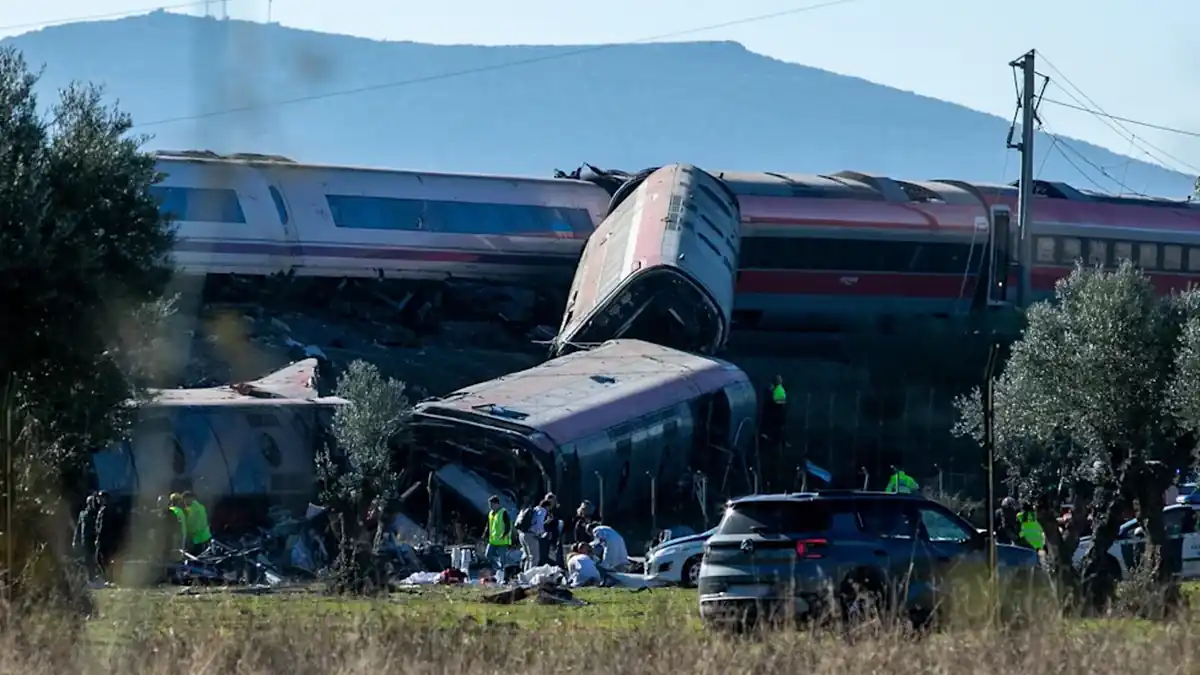
Spain’s rail network is the pride of the country, so Wednesday morning was a bad time for it to fail. It failed anyway, on a flat, straight stretch of line near the village of Urda in Toledo province. By evening, at least 68 people were dead and 58 injured, and the toll may still rise
Prime Minister Pedro Sánchez cancelled his schedule. A military emergency brigade was sent to help firefighters and police, and Wednesday’s Copa del Rey matches were postponed. When a country stops its football, it isn’t a routine accident.
Shortly before 9 a.m., a Renfe AVE bound for Seville with 397 passengers rear-ended an Iryo train carrying 147, which was stationary near kilometre 118 of the Madrid–Seville line. The back of the Iryo train took the force. Two carriages left the rails and fell down an embankment beside the track.
Regional president Emiliano García-Page said 24 of the dead were on the Renfe train and the rest on the Iryo. Spanish outlets put the seriously injured at around 15. Counts of the wounded vary between outlets, as they always do early on, and that is little comfort to relatives waiting outside hospitals.
Iryo said its train was “struck from behind” and that the cause was still unknown on its side. Adif, the infrastructure manager, shut all high-speed traffic between Madrid and Andalusia. Renfe offered free ticket changes. Nobody is going far on that corridor for a while.
This is where the story differs from most rail disasters on day one. The government isn’t saying “cause unknown”. It has given a timeline.
Speaking from Adif’s control centre in Atocha, Transport Minister Óscar Puente said that at about 8:30 a.m. a computer malfunction knocked out the signalling system over a long stretch of the line. Trains on that stretch were stopped. Six were held near Urda. By his account, the decision to proceed was made by 8:36. The Renfe train set off again, covered roughly 20 to 25 kilometres, and hit the Iryo train.
Puente described the order as “inexplicable”. He said a stop signal was still active on that section and that the rules limited a train moving through it to 40 km/h. The AVE was reportedly travelling far faster, potentially approaching 200. He said the drivers weren’t to blame, and he insisted he was not attributing responsibility to anyone and was simply stating the facts.
That is a careful sentence, and not a convincing one. The government’s first account of the crash, relayed by Spanish media, blamed human error by an Adif operator after the main signalling system failed. The Civil Guard and the national rail accident commission, CIAF, questioned the operator who was managing traffic at the time. The commission has opened its own inquiry, and as of Wednesday it hadn’t given an official cause. Everything above is the government’s version. It may well hold up, but it is still one side’s account.
January’s crash near Adamuz in Córdoba killed at least 45 people and was Spain’s deadliest rail accident since 2013. That one had a different origin: investigators found a roughly 40-centimetre break in a rail. Steel failed there. At Urda, on the government’s account, the failure was a software outage followed by a human judgement.
Two different causes, then, and the same two operators, Renfe and Iryo, sharing the same corridor both times. Spain has the longest high-speed network in Europe, and it ran for more than three decades without a fatal accident on it. Now it has had two within a year.
Whatever the final report says, it is hard to read the Urda timeline without asking about redundancy. Signalling systems are built on the assumption that computers fail and people make mistakes. The safeguard is a system that is safe to fail, one where a single order can’t put a fast train onto an occupied line. If one controller’s call could do that, the problem is bigger than one person.
Puente was asked on Wednesday whether he would resign and said he wasn’t considering it. Expect the question to return, along with a harder one about whether Adif’s procedures were followed or were themselves flawed. The prime minister has promised the country will get answers, and the BBC reported him saying the whole country is grieving.