
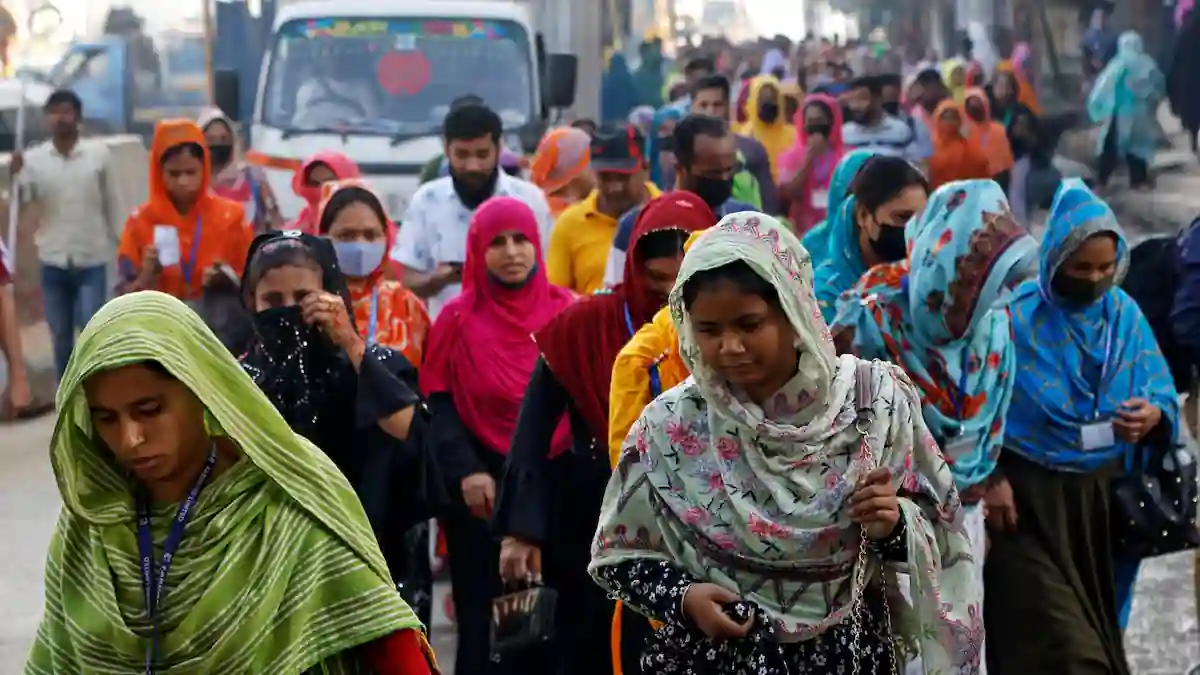
In under three weeks, global fashion brands have quietly yanked some $254 million in orders out of Bangladesh. Most of the work is going to India.
The figure is based on three factory owners, who told Reuters. They didn't want to be named as they still need those buyers to order next season. They said labels including Zara, H&M, Marks & Spencer and Celio shifted almost a tenth of their monthly Bangladesh orders to other Asian hubs between November 1 and 18.
Inditex, the parent company of Zara, declined to comment. M&S, H&M and Celio did not reply. So the number is based on what owners say, not anything the brands have verified.
It still hits hard. Clothing represents more than 80% of Bangladesh’s export earnings and nearly 40% of its manufacturing employment. The sector employs more than 4 million people.
The ugly thing is the timing. After nearly 12 hours of talks, a government wage board concluded early Wednesday, around 2 am, with a deal to set a new minimum wage of 17,000 taka a month, or about $138. The old figure was a fixed 12,500 taka in 2023.
The vote was 4-2. Four members supported 17,000. Two wanted 18,000.
Workers asked for 32,000 taka at first. They came down to 18,000 in negotiations. The owners opened 15,000 and moved up to 17,000, exactly where the board finished.
A 36% jump sounds generous, until you look at the history. It is the smallest percentage increase since the sector’s first minimum wage was introduced in 1986. The last three revisions were 77 per cent in 2013, 51 per cent in 2018 and 56 per cent in 2023.
Salaries will be from 17,000 taka for Grade 4 to 21,500 taka for Grade 1 under the new four-grade structure. The change takes effect Dec. 1, but workers won’t see the increase in pay until January.
They didn't wait until January to answer. Police fired tear gas and sound grenades to disperse workers who blocked a major highway in Gazipur on Wednesday. Labor ministry secretary Abdur Rahman Tarafder said the rise was satisfactory and hoped all would be back to work from Saturday.
The industry body, BGMEA, said 397 factories did not operate on Tuesday. Another 84 remained closed under the labor law’s “no work, no pay” provision.
Rights groups were also not impressed. The new rate is still a long way short of a living wage, the Clean Clothes Campaign said, criticizing brands for not explicitly supporting a higher figure.
ACT group brands – which include Inditex, H&M and Primark – had pledged to make sure any wage rises were passed on to the factories they pay. Reuters was told wages were “ring-fenced” and not part of H&M’s price negotiations, said H&M. According to its own published data, Bangladesh has the lowest minimum wage of its eight main production countries. There are 142 factories that source from there, employing 510,704 people.
Wages are only one part of the equation. Time is more important.
India can provide buyers with about a week’s delivery advantage, said BGMEA director M Mohiuddin Chowdhury to Reuters. Vietnam and Cambodia can shave up to 15 days off. Competitors typically finish and deliver in 60-90 days. Bangladesh takes around 120.
The strikes have worsened that gap. Factories around Dhaka are estimated to have lost 20 to 25 production days and some are considering overtime and costly air freight to meet delivery dates. The crisis in the Middle East has made energy shortages worse, forcing others to turn to more expensive backup power.
Chowdhury was blunt. If a brand has a hard deadline, price is not the issue.
Indian investors interpreted the report the same way. Shares of Gokaldas Exports surged up as much as 11% and Trident rose around 5%. Welspun Living, KPR Mill and Vardhman Textiles rose nearly 2% each.
“This new wage changes the maths for good,” said one manufacturer. Mohiuddin Rubel of Denim Expert Ltd, which supplies H&M and others, said the $138 now puts Bangladesh above West Bengal and on par with Vietnam, Indonesia and Pakistan. "Our main edge was low cost and now it is gone," he said.
This year his factory has already cut prices in Europe by 6.54% and still lost volume. He wants long-term, low-cost credit for synthetic fiber, automation and skills training, and faster port and customs clearance. He wants brands to share the higher wage bill because small factories can't afford it on their own.
Babul Akhter, a union leader and a member of the wage board, thinks the brands are hiding behind the protests. “It’s hard to blame the unrest when retailers are already factoring political instability into their sourcing,” he said.
Owners tell a different story than the shop floor. Khan Monirul Alam, Managing Director of Alps Apparels Group, which predominantly supplies European brands, said most of the buyers stopped placing orders from November 1. Orders were shifted, delayed or canceled and the buyers had found other outlets.
Politics is adding another level. Nerves are high amid tension over former prime minister Sheik Hasina's possible return to Dhaka from India, reportedly eyed for December 16.
The bill is already huge enough. BGMEA survey estimates loss of $428 million of production in 18 days of disruption for around 317 factories.
The longer-term worry is permanence. In a crisis, orders may shift, warned Chowdhury, and they may not revert when calm returns. “Brands have options,” he said. “If instability lasts too long, they will not wait.
The new wage structure will take effect from 1 December. How much more business slips away will depend on whether workers accept it and whether factories around Dhaka can run without interruption until then.






Comments 0