
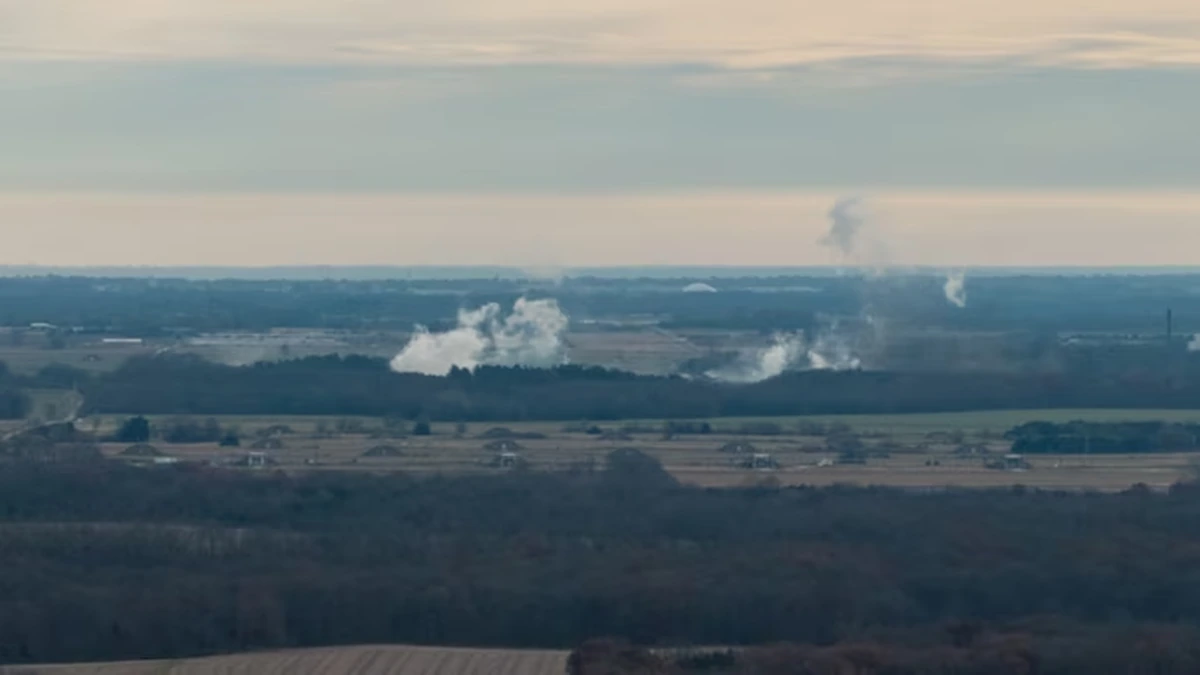
The U.S. Army destroyed 68 barrels of degraded lead azide at the Iowa Army Ammunition Plant on Wednesday. That’s almost five tons, or about 10,000 pounds. Two controlled explosions occurred simultaneously at about 9 a.m. Central time, at a plant just outside Middletown, a town of about 400 people in southeast Iowa.
Smoke and debris churned over the scene. Within hours, federal agencies were saying the initial air samples looked clean.
There were no secondary explosions, nothing was thrown outside the target area and no damage to buildings on or around the installation, the Army said. FEMA gave the area the all clear.
Lead azide is a primary explosive. It is the sensitive material that triggers larger charges in munitions. That is good on a production line and a pain in storage .
The barrels at Middletown had lain in dirt-covered magazines for decades, kept wet in a mix of water and ethanol. A safety review in March found the material had crystallized and degraded. That, the EPA says, made it more sensitive to shock and friction so that even moving the containers could set it off.
The Army’s argument was simple. It was too dangerous to move, and so the only responsible thing to do was to destroy it on the spot. The EPA agreed, and issued an emergency permit Nov. 13.
The concern was the plume. Officials warned the blast would stir up some lead dust and that it could remain for up to an hour depending on wind. Lead is poisonous, and the people who lived there knew that.
The blast was originally scheduled for Friday, Nov. 20. Several school districts closed down. Officials asked residents near the plant to leave.
Then the Iowa Environmental Council and the Sierra Club filed an emergency motion, saying the lead dust could travel more than 100 miles. The Eighth Circuit Court of Appeals put the permit on hold Thursday afternoon as it considered the request. The Army changed the date to Monday.
The administration told the court over the weekend it would use emergency legal powers to proceed anyway by Tuesday. Officials said the cold could make the material even more unstable.
Trump intervened Monday. He said the Army was ordered to stand down unless the appeals court agreed and Iowa governor-elect Democrat Rob Sand approved. He blamed the Obama administration for allowing the stockpile to get this bad, and said Sand would be held accountable if approval was withheld and something went wrong.
Later that day, the Eighth Circuit lifted its stay and denied the groups’ request. The judges recognized the risks of the planned blast were very real. They still decided that an uncontrolled explosion would be worse . The groups said they would not seek to block it further.
Sand neither approved nor disapproved the plan. It was a “consensus decision,” Army Acting Secretary Adam Telle said, and Wednesday was a done deal. By then the date had shifted three times.
What the EPA said: Its air monitors showed no airborne lead in real time. “Nothing was shown in the first half hour and then nothing again for about five hours after the explosion,” Administrator Lee Zeldin said. The Army said there was no lead on the ground.
"The blast met or exceeded expectations," said Gen. Eric Shirley, commander of US Army Sustainment Command. Trump said similar things on social media, and Iowa Gov. Kim Reynolds said the Army’s mitigation efforts had performed better than expected.
Here is the caveat. Air monitors only tell part of the story. Lead dust that does not remain airborne settles to the ground, and the location where it lands is predicted separately. Wednesday evening, there were no full environmental results. The EPA took over 1,200 air, land and water samples as a baseline before the blast and continues to sample soil, water and surfaces.







Comments 0