
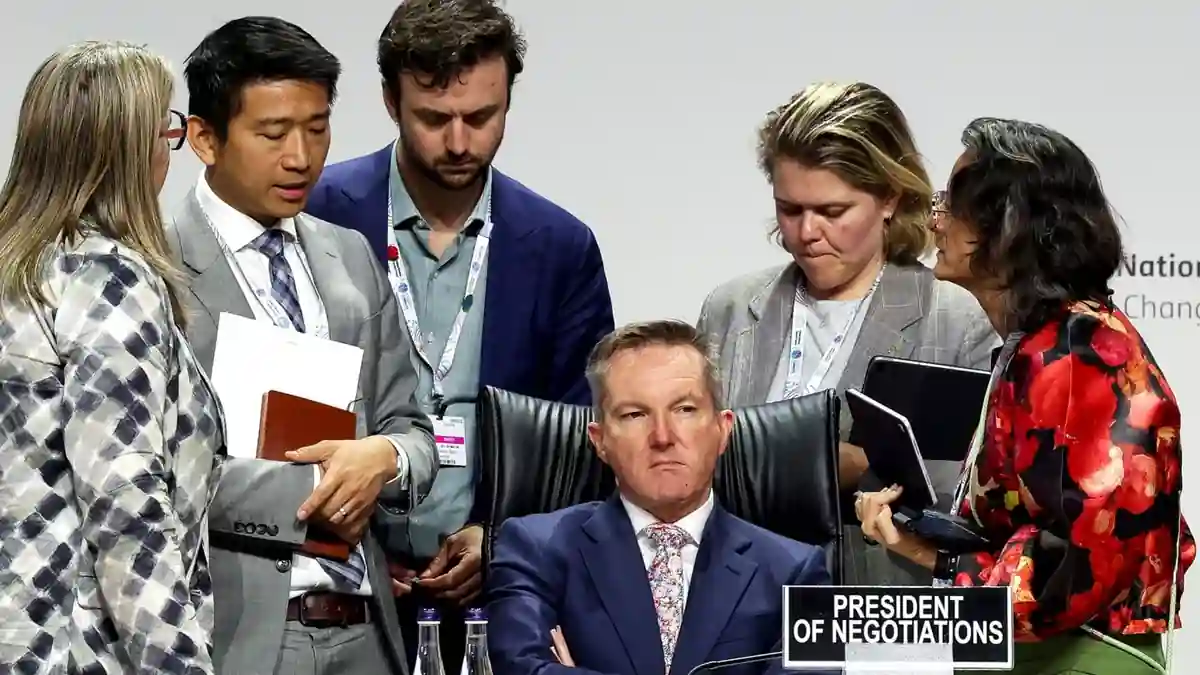
After grim work and discussions for over two weeks, nothing was hammered out in 48 hours of choreographed talks.
"We've done what we could do - we're not going to impose a text on the nations that object," said Kurum, who was the Turkey conference president, at the closing plenary Sunday. "We have nothing to do," Kurum said. U.N. climate rules require consensus and can be derailed by any one country objecting.
A far cry from recent summits. At COP30 last year, the Belem countries of Brazil accepted a watered-down text and a 'forget' of fossil fuel so that they would get a deal. This year, the patience for waiting had run out. More than 100 countries ruled no deal is better than a hollow deal, with the UN saying the world is already on course to blast past the 1.5°C limit of warming.
It's a battle over two absent words.
Powerful fossil fuel producers, spearheaded by Saudi Arabia, had fought furiously to remove any mention of phasing the world out of oil, gas, and coal, and the last draft purged it. That was a hard red line for Europeans and countries vulnerable to climate change.
It is 'unconscionable to enter into a climate pact that ignores the primary cause of warming,' said Ireland's climate minister Darragh O'Brien, fronting for the European Union. "We are not going to allow any 'greenwash' of fossil fuels in a COP," he said in the room. Panama also formally protested, saying the text was "a set back, roll back" that was too reliant on carbon capture and storage. Norway, Vanuatu, and the Marshall Islands jumped on board to dismiss it immediately.
Reporters said Saudi Arabia delegates wrangled in the last session, shocked at the position and the fact that fossil fuels make up an important part of their economy. "I believe that all options are still on the table," its representative said.
"It's outrageous that a handful of petrostates have a veto on any mention of fossil fuels," former US vise president Al Gore said outside the hall, calling for significant reforms to the UN process. Meanwhile, the US, which has walked out of the Paris Agreement, was not at the table, missing the summit for the second year running.
Fossil fuels were not all that split the room. Money was also of huge importance.
The initial draft of the Antalya Pact said adaptation ("losers") finance must "triple" to $120 billion come 2035. But wealthy nations didn't want to dedicate any of their $300 billion in climate finance for adaptation, and subsequent drafts quietly removed the figure.
That angered major developing countries. But India, China, and Saudi Arabia, which had lobbied with the LDCs, accepted the general structure of the cover text. India opposed explicit fossil-fuel phase-out language without finance and technology, arguing that these were already accounted for by developed countries' historical emissions: "the carbon budget is already gone."
"I am disappointed," said Li Gao, head of the China delegation, "that this collapse costs developing countries what developing countries need," but he added that the breakdown was "not the death of multilateralism."
The two-week summit was not an utter failure. "There are still a number of technical agenda items that are disputed, and more than 90 countries signed up to a voluntary electrification pledge," said Chris Bowen, Australia's COP31 president of negotiations. Countries debated whether Turkey's goal of 35% global electrification by 2035 should be solely clean energy.
All the long-simmering fights that are baked into the subtexts of fossil fuels and adaptation cash and electrification targets just go straight to COP32 in Addis Ababa, Ethiopia, next year.
It's unclear whether the collapse in Antalya will actually force governments to revisit the UN's unanimity rule or whether a handful of countries will continue to have veto power over that unwieldy assembly of almost 200 nations.
But the bigger question is if even Ethiopia can deliver a breakthrough, or if more real climate action will continue to migrate out of the UN negotiating halls, a spectator United States in tow, and emissions keep rising.





Comments 0