
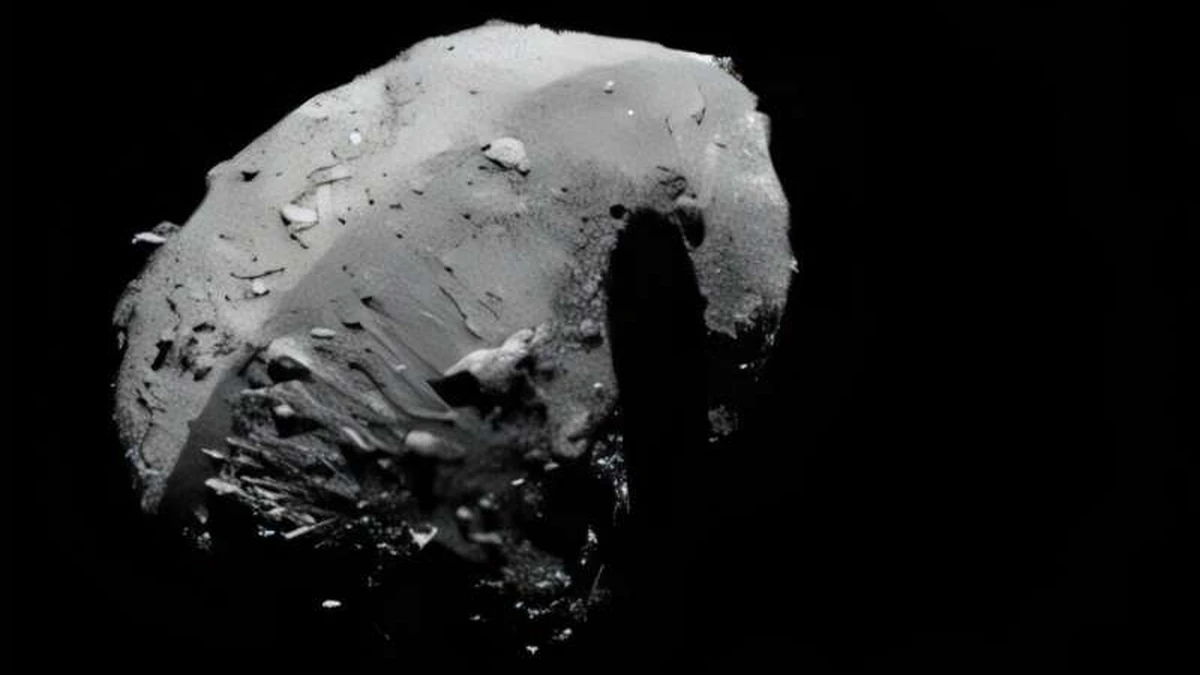
The European Space Agency has revealed what NASA’s asteroid-bashing experiment really did to its target. It’s tough to miss the main finding. On Wednesday, November 25, ESA published the first close-up images taken by its Hera spacecraft. DART slammed the side of Dimorphos, squashing it into an impact crater about the size of a sports stadium.
That crater is not a small indentation in one corner. According to ESA, it would span the entire width of an asteroid only some 151 meters across.
The Double Asteroid Redirection Test, or DART, struck Dimorphos on Sept. 26, 2022. It was the first time man had ever attempted to move a natural object in space. The spacecraft was obliterated on impact, and the small Italian camera satellite that flew beside it, LICIACube, could only capture images of a thick cloud of debris. Nobody saw the real wound.
Now Hera has seen it. “Scientists have been arguing about three possible outcomes: a crater, a reshaped asteroid or no real change at all,” said mission principal investigator Patrick Michel. He summed it up saying the answer was all three at the same time.
The rest of Dimorphos is weirdly familiar. When researchers compared Hera's images to DART's final frames, they observed that the boulder fields on the untouched regions looked the same as they did in 2022. A few individual rocks appear to have hardly moved at all.
Dimorphos is a rubble-pile. It’s not one solid rock, but a loose pile of pieces held together by very weak gravity, making it hard to predict how it will react to a hit. In simulations published as recently as 2024, DART may not have left a clean crater at all, with the whole body reshaped instead.
So the scar the size of a stadium settles it. It also gives engineers real evidence of how a rubble-pile asteroid behaves when hit, something a computer model can’t fully provide.
Before the impact, it was thought that Dimorphos was tidally locked to Didymos, much like our Moon is to Earth, always showing the same face to its larger companion. That’s finished.
Hera images show Dimorphos tumbling wildly as it orbits. “This became clear as more images came in,” said ESA’s mission scientist Michael Kueppers.
It is an improvement of the previous result. DART shortened Dimorphos’ orbit around Didymos by about 33 minutes. NASA said the 73 seconds was a success. Now it appears that the impact changed the moon's motion in more than one way.
The second surprise is crowding. Hera found hundreds of asteroids, some meters across, orbiting the two asteroids.
Some may be remnants of DART. In 2023, a standard Hubble Space Telescope spotted 37 boulders, between about one and seven meters wide, that appeared to have been shaken loose from Dimorphos by the collision. An open question is where the bigger population around the pair came from and answering this should help scientists reconstruct what happened in the seconds after impact.
There is a practical headache for the mission team too. Hera is flying through a debris field it didn’t expect and the team will have to plan around those boulders as it gets closer.”
Hera arrived at the system on 4 November and is now hovering at a distance of some 25-30 km. It will come within 13 kilometers in December for sharper pictures of the crater.
Two shoebox-sized CubeSats will launch in January. One, named Juventas, will perform the first radar measurements of an asteroid’s interior. The other, Milani, will study the environment surrounding it. They will combine with Hera’s own instruments to map Dimorphos’ mass and internal structure.
This is important because it will tell scientists how effective DART was at transferring its momentum to the asteroid. If it was a different structure the same impact would have a different push.
Didymos, or Dimorphos, does not pose any threat to Earth. They chose the pair because they were safe to experiment on.
The play book is the point. DART showed that a spacecraft can change the orbit of an asteroid. Hera will reveal what the asteroid itself has experienced. Together the two missions bring humanity one step closer to making asteroid deflection a reliable tool," said ESA mission manager Ian Carnelli.
But there is still work to do before anyone can call it reliable. Hera will spend a few months studying the system, measuring the crater and mapping the surface of Dimorphos in detail. The first images are coming in, and the real analysis is just beginning.







Comments 0