
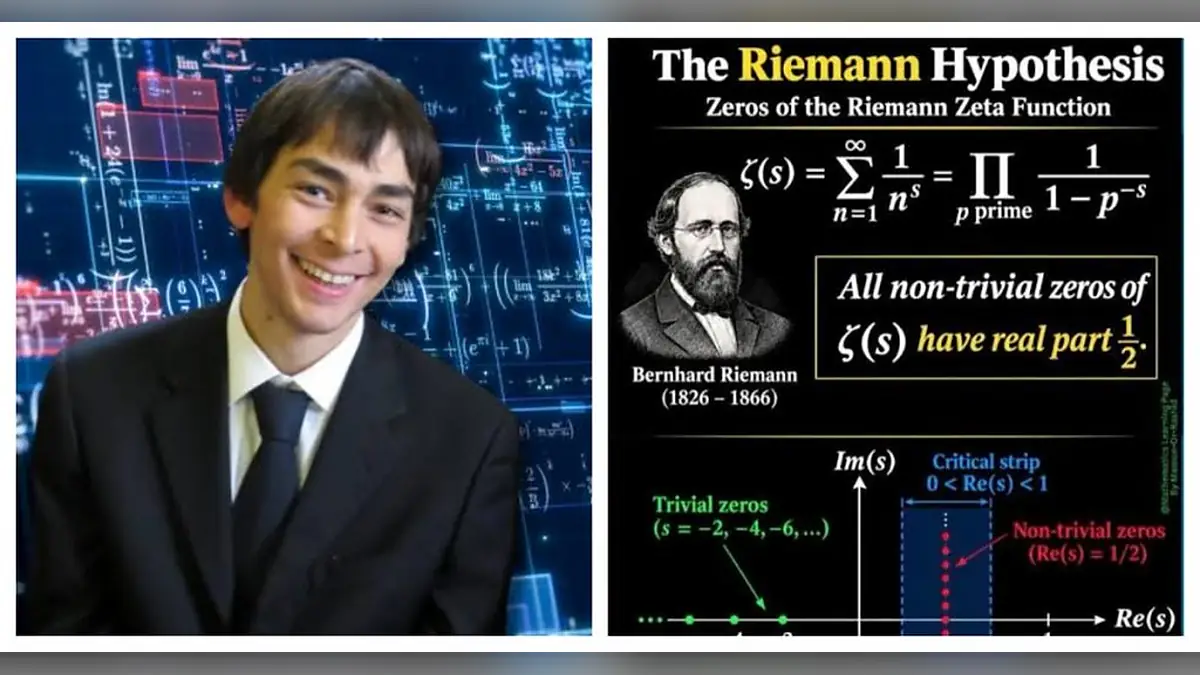
The Riemann Hypothesis has become one of the popular subjects in the US following the announcement made by Levent Alpöge, a mathematician at artificial intelligence company Anthropic, who claims to have proved a famous mathematical conjecture with the help of Anthropic's AI assistant, Claude.
This news, which has been published on November 20, 2026, has drawn the attention of many mathematicians, technology scientists, and AI specialists. In particular, this is a very important point because the problem has stayed unsolved since its formulation by German mathematician Bernhard Riemann back in 1859.
However, there is no suggestion that the scientific community has recognized this proof as it should be independently analyzed and understood.
The Riemann Hypothesis is one of the most famous conjectures in mathematics. The hypothesis deals with the distribution of prime numbers, which is defined as numbers greater than one and divisible only by themselves and one.
There are prime numbers like 2, 3, 5, 7, 11, and 13 used in different parts of mathematics. Despite the presence of approaches for studying the distribution of prime numbers, there is still no exact explanation of their occurrence.
Bernhard Riemann suggested the hypothesis in 1859. He stated that all non-trivial zeros of the Riemann zeta function belong to a certain vertical line in the complex plane where the real part equals to one-half.
Proving the Riemann Hypothesis will allow understanding more about the distribution of prime numbers better. There are also connections with different statements in number theory.
Alpöge reported that he collaborated with Claude in developing the mathematics behind the claim. While he initially steered the process to some sort of idea, he noted that the AI technology later contributed much mathematical reasoning.
The scientist published a four-page document detailing his claims along with a formal version of the alleged proof in Lean, which is a computer programming language that helps to write mathematical arguments.
The extent of the project is huge; the reports suggest that the formal verification involves about 17 million lines of code, and Alpöge himself believes that it would take hundreds of thousands of pages to explain the proof in writing.
The use of Lean is significant here since it can help to find out whether the mathematical argument is based on correct logic. However, the successful formal check does not necessarily mean that the argument has been comprehended by the independent mathematicians or that it is indeed a formalisation of the mathematical result.
The news caused various reactions among the mathematics community.
While some researchers have been excited about the prospect that the technology might help solve one of the longstanding problems for mathematicians, Fields Medal recipient James Maynard of the University of Oxford noted that the achievement will go down in history as a milestone, but acknowledged that the proof would take a lot of time to verify.
Other scientists have found it difficult to analyse the materials. Number theorist Andrew Granville was critical of the transparency of the published explanation, while researchers noted that the huge size of the formal proof made independent analysis more difficult.
The main problem, however, is not only that the computer can validate the code. Mathematicians have to prove that the proof is mathematically correct and make sense of the logic behind the claimed theorem.
Adding one more layer to the controversy, reports have emerged about the second mathematician making an attempt to solve the problem.
As per The Times, Masullo published a 940-page human-written proof. The work was published amid fears that it would be overshadowed by yet another announcement.
It has led to an odd occurrence where two distinct techniques have been used to address the same historic mathematical problem; one with the help of formal proof done using Artificial Intelligence and the other through a traditional mathematical proof.
Neither of these claims has managed to achieve the required independent confirmation that would enable the mathematical community to announce the resolution of the Riemann Hypothesis.
Riemann Hypothesis is one of the seven Millennium Prize Problems chosen by the Clay Mathematics Institute in the year 2000.
The institute chose to provide a reward of $1 million for every challenge that achieves an acceptable solution. The problems were chosen based on their fundamental nature and how important they could be to advancing mathematics.
However, merely claiming the solution of a problem is not enough to earn the prize. A solution must meet the institute’s criteria including being published in the right peer-reviewed journal and undergoing mathematical verification.
The institute still considers the Riemann Hypothesis as an unresolved problem.
The debate shows that the use of artificial intelligence for advanced mathematics research is becoming more common.
There is an increasing trend towards the application of artificial intelligence systems in the exploration of mathematical concepts, aiding in the process of calculating complicated calculations, identifying potential paths, and proving theories. Claude's involvement in the process of claiming the Riemann Hypothesis has made people wonder about the extent of the contribution that AI systems can make in mathematics.
If the claim turns out to be true, then this will prove to be a significant step in the realms of mathematics and artificial intelligence-based scientific research. This will show that AI systems can help solve such questions which human generations could not solve despite all their efforts.
On the other hand, the announcement will bring up the questions of mathematical knowledge, human experience and the difference between a proved result and its explanation.










Comments 0